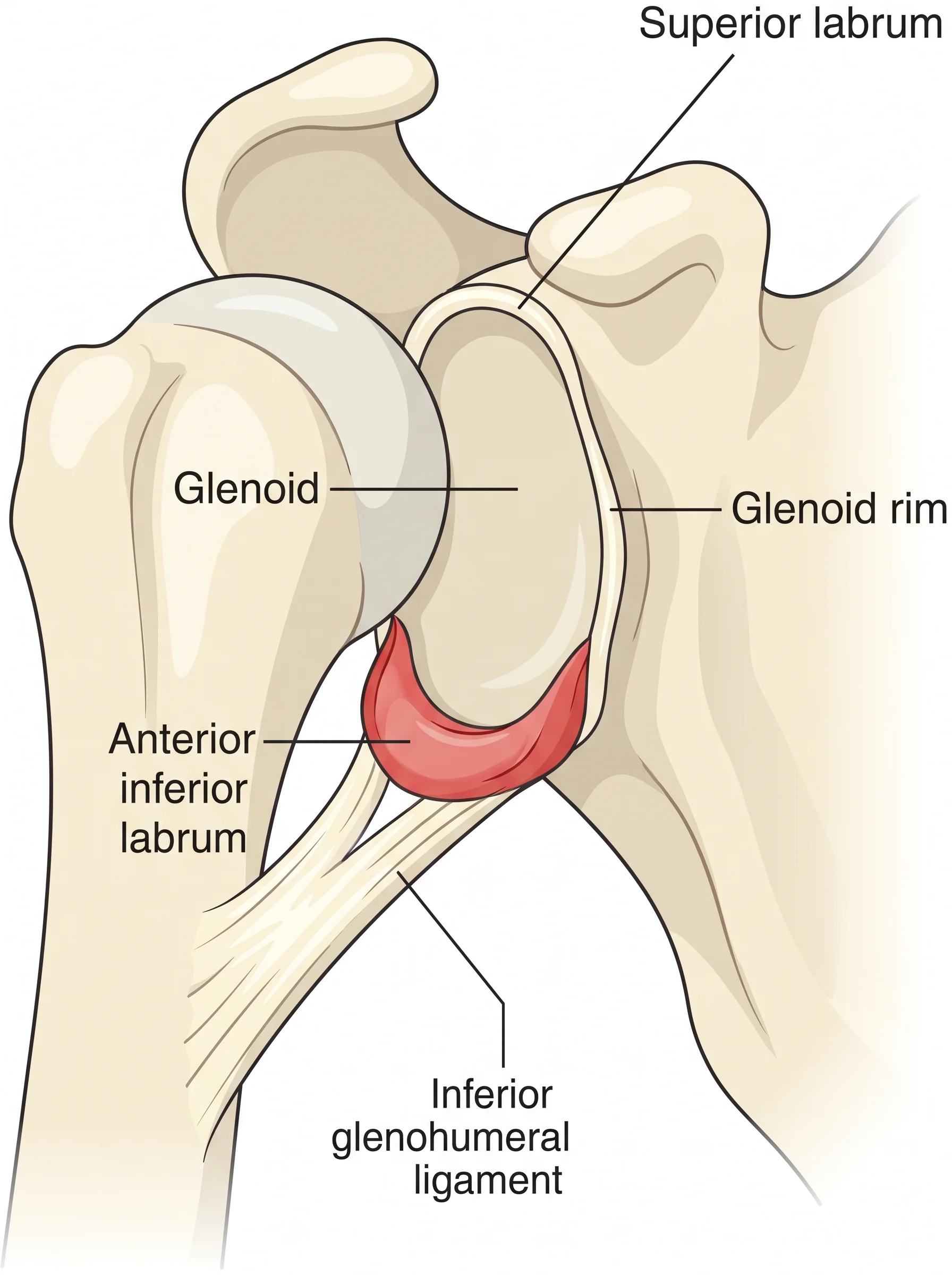
A Bankart repair is surgery to fix a torn labrum in the front of the shoulder after the joint has dislocated. The surgeon reattaches the torn tissue to the socket rim so the shoulder stays in place. Most repairs are done through small incisions with a camera. This guide explains the procedure and recovery.
Kevin Plancher performs bankart repair (stabilization) in New York when it is the right step, and reviews every alternative with you first.
What is a Bankart Repair, and who is it for?
The shoulder is a ball-and-socket joint.
The round top of the arm bone, called the humeral head, sits against a shallow socket on the shoulder blade, called the glenoid. Because the socket is shallow, the shoulder moves more than any other joint in the body. A rim of soft tissue called the labrum deepens the socket and helps hold the ball in place.
When the shoulder dislocates, meaning the ball comes fully out of the socket, the front-lower part of the labrum often tears away from the bone. This specific tear is called a Bankart lesion, named after the surgeon who described it. Once the labrum is torn, the shoulder has less to hold it in place, and it can dislocate again more easily. Repeated dislocations are called shoulder instability.
A Bankart repair is surgery that reattaches the torn labrum to the rim of the socket. The goal is to rebuild the front barrier that keeps the ball centered, so the shoulder stops slipping out.
This surgery is usually considered for people who have had one or more full dislocations and whose shoulder keeps feeling loose or gives out during normal activity. It is common in younger, active people, because a first dislocation before age 25 carries a higher chance of happening again, according to general guidance from the American Academy of Orthopaedic Surgeons (AAOS). These are ranges of risk, not certainties. Dr. Plancher evaluates each shoulder individually and does not recommend surgery based on age alone.
What are the symptoms of Bankart Repair (Stabilization), and when should you see a specialist?
People who may benefit from a Bankart repair often describe their shoulder in plain terms.
Common experiences include the following.
- A shoulder that has fully come out of the socket, once or more than once. - A feeling that the shoulder is about to slip out when you reach overhead or behind you. - Catching, clicking, or a dead-arm feeling during throwing or lifting. - Avoiding certain positions, like reaching back to put on a seatbelt, because the shoulder feels unstable. - Aching in the front of the shoulder after activity.
Not every shoulder that has dislocated needs surgery. Many first-time dislocations are treated without an operation. It is reasonable to see a shoulder specialist when the shoulder has dislocated more than once, when it keeps feeling loose during everyday tasks, or when instability is interfering with work, sport, or sleep. A specialist can tell the difference between a shoulder that will settle with therapy and one that is likely to keep slipping.
This section describes symptoms so you can decide whether to be evaluated. It is not a diagnosis. Only an in-person exam and imaging can identify a Bankart lesion.
How is Bankart Repair (Stabilization) diagnosed, and what does the visit involve?
A visit for shoulder instability usually has three parts.
First, a conversation. Dr. Plancher will ask how the shoulder first dislocated, how many times it has happened, what positions bring on the loose feeling, and how it affects your daily life. The history often points to the diagnosis before any test.
Second, a physical exam. The surgeon gently moves the arm into different positions to see where the shoulder feels unstable. One common test moves the arm out and back, the position where a front dislocation is most likely, to check for apprehension, meaning the guarding feeling that the shoulder is about to slip. The exam is done carefully and stops if it reproduces that feeling.
Third, imaging. X-rays show the bones and can reveal whether any bone was chipped off the socket during a dislocation. An MRI, which is a scan that shows soft tissue, is often used to see the labrum directly. Sometimes a dye is injected into the joint before the MRI, called an MRI arthrogram, to outline the labral tear more clearly. If there is concern about bone loss from the socket, a CT scan, which is a detailed bone scan, may be added. Bone loss matters because it can change which surgery is the right one.
What happens during Bankart Repair (Stabilization), step by step?
Most Bankart repairs today are done arthroscopically, meaning through small incisions using a camera called an arthroscope.
Here is what typically happens, in order.
Anesthesia. You receive anesthesia so you feel no pain. This is often a general anesthetic, sometimes combined with a nerve block, which is an injection that numbs the shoulder and helps with pain afterward. The anesthesia team reviews the plan with you beforehand.
Positioning. You are placed either on your side or in a partly upright seated position, depending on the surgeon's approach. The arm is prepared and draped.
Camera and inspection. The surgeon makes a few small incisions, each usually under half an inch. The arthroscope goes through one, and thin instruments go through the others. Sterile fluid gently expands the joint so the surgeon can see. The whole inside of the shoulder is inspected first, so any additional problem is found.
Preparing the bone. The torn edge of the labrum is freed, and the rim of the socket where it will reattach is lightly roughened. This helps the tissue heal back to the bone.
Placing anchors. Small anchors, which are tiny devices set into the bone, are placed along the socket rim. Sutures, meaning surgical threads, run from these anchors. Some anchors dissolve over time and some do not; both are designed to stay put.
Reattaching the labrum. The surgeon passes the sutures through the torn labrum and ties or secures them, pulling the tissue snugly back against the socket rim. This restores the bumper that deepens the socket and tightens the front of the joint.
Closing. The instruments come out, the small incisions are closed, and the arm is placed in a sling.
Most Bankart repairs are outpatient, meaning you go home the same day. In some cases the surgeon may recommend an open repair, done through one larger incision, particularly when there is more bone loss or a previous repair. If your situation calls for a different procedure, such as a Latarjet, Dr. Plancher will explain why. See the Latarjet Procedure guide for that comparison.
What is the recovery timeline for Bankart Repair (Stabilization)?
Recovery is clearest when understood by milestones, meaning what your shoulder can do, rather than by the calendar alone.
Typical calendar ranges are included from the American Academy of Orthopaedic Surgeons, and these are ranges, not promises. Your timeline depends on the size of the repair, your health, and how your body heals.
Phase 1, protection (about weeks 0 to 4 to 6). The sling protects the repair while the labrum begins to heal to the bone. You can usually do gentle hand, wrist, and elbow movement right away. The milestone here is comfort at rest and letting the tissue anchor down. Pushing motion too early is the main way a repair is put at risk.
Phase 2, restoring motion (about weeks 4 to 12). With your surgeon's clearance, the sling comes off and physical therapy begins guided range-of-motion work. The milestone is regaining smooth, pain-controlled motion in stages, not forcing the shoulder into the positions that caused instability. Reaching overhead and rotating outward are added gradually.
Phase 3, strengthening (about months 3 to 4 onward). Once motion returns, therapy shifts to strengthening the rotator cuff and shoulder-blade muscles. The milestone is control: being able to move the shoulder through its range with strength and without the loose feeling.
Phase 4, return to activity (about months 4 to 6 and beyond). Return to contact sports or heavy overhead work is usually the last milestone, based on strength, motion, and confidence rather than a date. According to AAOS general guidance, return to full sport commonly falls in the four-to-six-month range and sometimes longer. The criterion is readiness, not the number on the calendar.
Your surgical team maps these phases with you and adjusts them to how you heal.
Read the full guide to preparing for surgery →
Your own recovery instructions come from the office and are specific to you. This page describes the general course, not a plan to follow.
How should you prepare for surgery?
Planning ahead makes recovery smoother.
Practical steps.
At home. Set up a spot where you can rest partly upright, since lying flat can be uncomfortable early on. A recliner or a wedge pillow helps. Place everyday items, like phone chargers, medications, and water, within reach of your non-surgical arm. Loose, button-front or zip shirts are far easier than pullovers while your arm is in a sling.
Transportation. You cannot drive yourself home after anesthesia. Arrange a ride, and plan for someone to drive you for as long as you are in the sling and taking pain medication, often a couple of weeks.
Time off. Desk work is often possible within one to two weeks, sometimes with the arm still in a sling. Physical or overhead work takes longer and should be discussed specifically. Ask your surgeon what your job will require.
Help on hand. Have someone available for the first day or two for meals, dressing, and getting settled. Simple one-handed tasks, like opening jars or tying shoes, are harder than expected at first.
Before the date. Follow the instructions about eating and drinking before anesthesia. Tell the office about all medications and supplements, since some, including blood thinners, may need to be paused. If you smoke, ask about stopping, because it can affect healing.
Which warning signs should you call about?
Most recoveries are uneventful.
Call the surgical office if you notice the following.
- A fever over 101 degrees Fahrenheit, or chills. - Increasing redness, warmth, or drainage from an incision, especially cloudy or foul-smelling fluid. - Pain that keeps getting worse instead of slowly easing, or pain not controlled by your prescribed medication. - New numbness, tingling, or weakness in the hand or arm that does not go away when you reposition. - The sling or dressing feeling far too tight, or fingers that look pale or swollen.
Seek emergency care right away for chest pain, trouble breathing, or a calf that becomes swollen, red, and painful, since these can signal a blood clot, which is a serious but uncommon problem after surgery.
For questions during business hours, call the office of Kevin Plancher at (212) 876-5200. Office hours are . For urgent problems after hours, follow the after-hours instructions your surgical team gives you, or go to the nearest emergency department.
What results can you expect from Bankart Repair (Stabilization)?
Bankart repair has a long track record for restoring shoulder stability.
Reported results depend heavily on the patient, especially age, activity, and how much bone was lost from the socket.
Across the orthopedic literature and consistent with general guidance from the American Academy of Orthopaedic Surgeons, arthroscopic Bankart repair returns stability to the shoulder in a large majority of patients when bone loss is minimal. Recurrent instability, meaning the shoulder dislocating again after surgery, is reported across a range that is higher in young contact athletes and in shoulders with significant bone loss, and lower in older or lower-demand patients. These are ranges reported across different studies and populations, not promises about any one shoulder.
The practical point is that a Bankart repair is well suited to shoulders with a torn labrum and little bone loss, and that other procedures, such as a Latarjet, may be recommended when bone loss is greater. Dr. Plancher will explain which situation applies to you and why, using your own imaging.
Numbers here are general and attributed on purpose. Your expected result is a conversation with your surgeon, based on your exam and scans.
Who performs bankart repair (stabilization): a complete guide in New York?
Kevin Plancher is a board certified orthopedic surgeon who performs bankart repair (stabilization): a complete guide in New York, NY. Fellowship trained at The Steadman-Hawkins Clinic, Vail, CO – Shoulder and Knee Reconstruction & Sports Medicine, The Indiana Hand Center, Indianapolis, IN – Hand & Microvascular Surgery. Dr. Plancher sees patients at the practice in New York; appointments can be requested through this site.
What do patients ask most?
What do patients ask about Bankart Repair (Stabilization)?+
How do payments work?
Contact the office to confirm insurance participation.
Fellowship trained at The Steadman-Hawkins Clinic, Vail, CO – Shoulder and Knee Reconstruction & Sports Medicine, The Indiana Hand Center, Indianapolis, IN – Hand & Microvascular Surgery. Sees patients in New York.
About Dr. Plancher →